
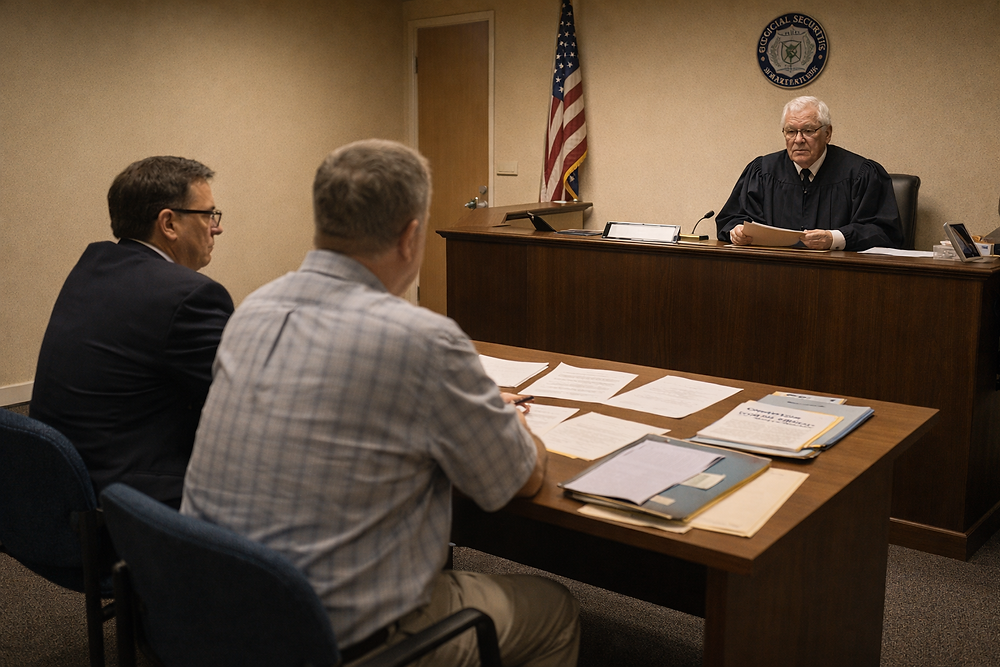
You are getting ready for your Social Security disability hearing, and someone in your family wants to help. Technically, yes, a family member can testify. In practice it’s rare, and our attorneys generally don’t encourage it, because live testimony from a relative doesn’t do much to help the case.
What we ask family members to do instead is put what they see in writing. A short function report, plus a simple day-to-day log of your symptoms and activities, tends to carry far more weight with a judge than an appearance at the hearing itself.
Who Can Testify at a Social Security Disability Hearing
- Lay witnesses, who include family members, friends, neighbors, caregivers, and former co-workers.
- Expert witnesses called by the administrative law judge, usually a vocational expert and sometimes a medical expert.
- The claimant, who almost always testifies and answers the judge’s questions about medical condition, work history, and functional limitations.
That is what the rules permit. What usually happens is narrower. In most hearings the claimant testifies, the vocational expert testifies, and family support reaches the judge in writing instead.
How ALJs Weigh Family Member Testimony
Administrative law judges hear lay testimony all the time, and they apply it carefully. A judge already expects your family to be supportive, so testimony that simply confirms you are struggling rarely changes the outcome. What decides cases is objective evidence about function, and family members are usually better positioned to document that than to speak to it at a hearing.
Most hearings are also held by phone or video now, so there often is not a room for a family member to stand up in even if they wanted to testify. That makes the written record, especially a day-to-day log of your good days and bad days, more useful than ever.
Third-Party Function Reports Do the Real Work
Family members do not need to attend the hearing to support a claim. The SSA uses a third-party function report, Form SSA-3380, which lets someone close to you describe what they actually observe: how long you last on your feet, what you have stopped doing on your own, what you need help with, and how often a bad day takes the whole day.
A report written by someone who is with you daily gets the same observations in front of the judge, in the record, before the hearing ever starts. That is the approach our team uses.
What Makes a Report Useful
- Specific detail grounded in what the person has personally seen.
- Consistency with the medical records and with your own description.
- Concrete examples rather than general statements about pain or difficulty.
What to Avoid
- Guessing at diagnoses or describing symptoms the person has not actually seen.
- Offering legal conclusions, such as saying the claimant is disabled, rather than describing observations.
- Exaggerating limitations beyond what the medical records support.
Medical Source Statements Carry the Most Weight
The strongest support in most files does not come from family at all. It comes from the providers treating you. A Medical Source Statement is a form your doctor completes describing exactly what you can and cannot do, including how long you can sit or stand, how much you can lift, and how often you would be off task or absent from work.
That level of detail is what judges rely on, and it is the piece most claims are missing. Liner Legal keeps Medical Source Statement forms available so you can bring the right one to your provider.
How Liner Legal Builds the Record
A Social Security disability attorney handles this as part of building the file: identifying who should complete a third-party function report, making sure the right Medical Source Statement reaches the right provider, and confirming everything lines up with the medical records. Our team coordinates all of it by phone and secure document exchange.
Frequently Asked Questions
Can a family member testify at my disability hearing?
Yes, but it is uncommon. Judges allow it, and in most cases a written third-party function report accomplishes the same thing more effectively.
What is a third-party function report for disability?
Form SSA-3380 lets a family member, friend, or caregiver describe how a disability affects the claimant’s daily activities.
What does a lay witness mean in court?
A lay witness is anyone who is not an expert. At a disability hearing, that usually means family members, friends, caregivers, or former co-workers who can describe what they have observed.
What not to say at a SSDI hearing?
Avoid guessing about diagnoses, exaggerating limitations, or describing symptoms the witness has not personally seen.
Beyond Disability: Our Referral Partner Network
While Liner Legal focuses exclusively on Social Security Disability (SSDI/SSI) and Long-Term Disability (LTD) claims, many of our clients are dealing with other legal challenges at the same time.
Did you know you may be entitled to additional financial compensation beyond your disability benefits? Depending on your situation, you could also have a workers’ compensation, personal injury, medical malpractice, or long-term disability claim. Exploring these options does not automatically affect your eligibility for Social Security Disability benefits.
At Liner Legal, we’re committed to helping you identify every potential source of financial support so you don’t leave benefits you may be entitled to on the table.
See if You Qualify for Additional Financial Compensation
Build a Stronger Disability Case With Liner Legal
If you are preparing for a Social Security disability hearing and want to know what evidence will actually carry your claim, our team at Liner Legal is ready to help.
See if You Qualify for SSD/SSI Benefits. Our attorneys work on a contingency fee basis, which means nothing up front and no fee unless we win benefits. Federal law caps our fees at 25 percent of past-due benefits or $9,200, whichever is lower.